Pounding Surf, Kaena Point State Park, Oahu, Hawaii
HOME PAGE | FINE ART GALLERY | FINE ART PRINTS | TRAVEL GALLERY | ARTICLES & TIPS | RESOURCES | DOWNLOADS | MY BLOG | ABOUT
Articles & Tips
PHOTO HOW TO
10 Practices for Better Landscapes 
10 Practices for the Traveling Photographer  

TRAVEL
Destination: Alice Springs, Australia  

Favorite Places: Kaena Point, Oahu, Hawaii  

Favorite Places: Moeraki Boulders, New Zealand  

Favorite Places: Watarrka National Park, Australia  

Photo Spot - Devils Marbles, Australia  

Trip Notes: Hawaii Volcanoes National Park, Hawaii  

Walking on Clouds – Haleakala Sunrise, Maui, Hawaii  

GENERAL
Building Your Photo Website  

In Defense of Film  

Photographers Bookshelf  

 
Would you like to be notified when a new article is published? If so, simply fill out your email address and click 'Subscribe'.


Make a donation with PayPal - it's fast, free and secure! While all items on this page are free, those who wish, may make a small donation to help offset the costs of producing them.
 
10 Practices for Better Landscapes  

“There are no rules for good photographs,
there are only good photographs. - Ansel Adams”

Ansel Adam’s definition of what makes for a good photograph leaves plenty of room for individual interpretation. In spite of this explanation, it is well known that Ansel was very meticulous when it came to the process of making a photograph; in planning for the photograph, taking the photograph, and then preparing the final result.

I approach photography in the same manner as Ansel did, with deliberation and planning, and as a result I have developed a few practices along the way. These have evolved primarily as a result of the type of photography I practice, large format landscape photography, and to suit my personality.

Shoot during the most attractive light of the day at sunrise and sunset when the sun is within a few degrees of the horizon (above or below); think of these times as the “magic hours”. The length of this “magic hour” varies based upon your location. Additionally, when the weather turns bad, don’t put your cameras away, bad weather can sometimes make for simple, strong compositions. Bad weather combined with the “magic hour” can make for a once in a lifetime shot. In the same manner, don’t be too quick to pack up your camera after the sun sets, the best light of the day sometimes happens shortly after sunset.

Use side lighting. Schedule your shot for the time period or search for a location where the subject's main features are lighted from the side. Light coming from the side can produce richer images as the light casts shadows that define shapes and provide texture. This can be difficult light to photograph in, because of the extremes of contrast; areas of the image may contain washed out white highlights, or unrecognizable black shadows.

Use a tripod. Using a tripod not only helps you organize your composition, by forcing you to slow down the photographic process, but it also enables you to achieve sharper pictures by keeping the camera steady. Beware of some of the cheap tripods that are currently available on the market, they can be quite unstable under a load or in windy condition. While more expensive, the newer carbon fiber tripods are much lighter and sturdier than the traditional aluminum ones. Carbon fiber tripods make transporting a tripod much less of a chore; an important bonus for the photographer who needs to travel long distance or travel by air.

Use Transparency film. For the most vibrant color, and the sharpest images, use a fine-grained transparency film. I prefer Fujichrome Velvia or Kodak VS 100. For those instances where a more neutral colored film is desired, I use Fujichrome Provia F100. Many professional photographers overexpose transparency film by 1/3 of a stop for increased saturation (exposing Fiji Velvia at E.I. 40).

Shoot at a small aperture. This will maximize depth of field and add a feeling of depth and sharpness. Most modern day lenses achieve their maximum sharpness at one or two f-stops above the minimum aperture; for example, if the minimum aperture is f32 then set the lens for f22 or f16. Additionally, try focusing slightly ahead of the main subject, so as to increase the perceived depth of field.

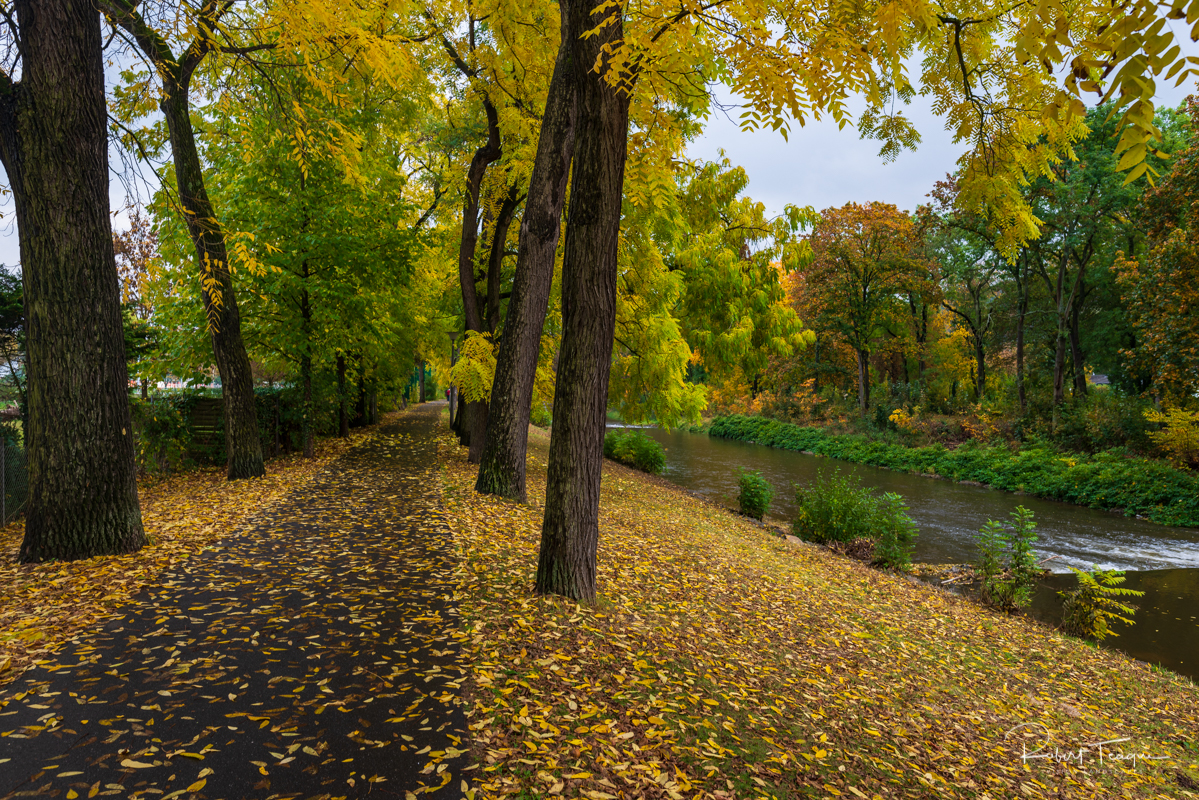
Use filters sparingly. A good photograph shouldn’t succumb to over-filtration. Properly using filters sparingly can enhance composition, without being overly garish. For example, a warming filter in the 81 series (such as an 81A or a Tiffen 812) can be used to enhance the warmth of sunlight in a composition, or when shooting in shade or overcast conditions. Likewise, an enhancing filter (such as the Tiffen Enhancing Filter) can be used to enhance the warm colors in a scene (with modern saturated films, this filter should be used sparingly); for example causing warm colored autumn leaves to stand out. A polarizing filter can be used to increase color saturation of foliage and intensify the color of the sky, but should be used sparingly with wide angle lenses.

Extinct cinder cone, Big Island, Hawaii

Use a split neutral density filter. I have found that the most useful filter of all is a graduated neutral density filter. These are square filters, clear on one half, with a neutral density base on the other, are usually in one, two or three f-stop increments. This filter allows you to reduce the contrast between light and dark areas of the scene.

Know before you go. Study the area that you are going to be photographing in; there are plenty of methods available for researching a location prior to going out. Your time when shooting landscapes is too precious to waste driving to a location that isn't conductive to the types of photographs you wish to take; the key is pre-planning. For example, on the Island of Oahu, my favorite spot to photograph is Kaena Point; but I know that during the summer months, the sun sets to the north of the point, in an area that isn't really spectacular for sunset shots. As a result, I schedule most of my trips there for the winter months. A little research before you go, can make the difference between a trip with great results and a wasted one.

Scout locations. It's a challenge to make good use of the time outside of the “magic hours”, between 9 a.m. and 3 p.m., as the sun is high and casts harsh shadows. The sunlight during this time period often results in harsh glare and shadows. Instead use the time you are not shooting to scout locations for afternoon or morning shots.

Take notes. While not strictly a photography tip, taking notes while in the field can literally save days of research when trying to remember where a particular image was taken (for captioning purposes), or for recording the technical details of an image. This can be useful when trying to find the location at a later date. I have found that a small notebook, combined with one of the new, cheap digital cameras (for taking pictures of signs, etc) works quite well.

These practices are not meant as a checklist of do’s and don’ts to be slavishly followed, but rather as a starting point for a successful photography trip. They have helped to me to develop a deliberate and thoughtful approach to my photography as well as the world around; landscape photography to me is all about a quiet contemplation of the natural world.

 
Additional Reading
Large Format Nature Photography Large Format Nature Photography
By  Jack W. Dykinga

Purchase this book from Amazon.com


Photographing the Landscape: The Art of Seeing
By  John Fielder

Purchase this book from Amazon.com


Tom Mackie's Landscape Photography Secrets Tom Mackie's Landscape Photography Secrets
By  Tom Mackie

Purchase this book from Amazon.com


Copyright (c) 2003 Robert M. Teague. Article may not be reproduced without written permission.

Submit Feedback


Back to Top


Photography articles at About.com

Have Some Fun! - 
Top 5 Sites to "Play" With Your Photos -  Sometimes even photographers want to just relax and do silly things. What ...


Forum Flashback Series - 6 March 2010 - 
Winner and Finalists of Assignment #63 - Action - 


Photo of the Week - March 3, 2010 -  Nature's Abstract Art

February Forum Theme Winner - 
Photography Assignment #64 - Zoo Photography - 
Forum Flashback Series - 27 February 2010 - 
Is Your Child a Leprechaun? - 
Photo of the Week - February 24, 2010 -  Show Off

What Affects Photo File Sizes? - 
Winner and Finalists of Assignment #62 - Sound - 


Forum Flashback Series - 20 February 2010 - 
Print Sizes -  So you've captured an amazing photograph and you order a 8x10 print of the ...


Photo of the Week - February 17, 2010 -  Barn & Windmill

Photography Assignment #63 - Action - 
Last Day to Enter the "Sound" Assignment -  ...


Forum Flashback Series - 13 February 2010 - 
Photography Magazines -  Photography magazines long had the monopoly on getting photography informat...


Photo of the Week - February 10, 2010 -  Tractor

Valentine's Day is Sunday - 


Forum Flashback Series - 6 February 2010 - 
Winner and Finalists of Assignment #61 - B&W - 


Photo of the Week - February 3, 2010 -  After the Storm

Details For Photography Assignment #62 - Sound -  ...

HOME PAGE | FINE ART GALLERY | FINE ART PRINTS | TRAVEL GALLERY | ARTICLES & TIPS | RESOURCES | DOWNLOADS | MY BLOG | ABOUT
All images and content are  © Copyright Robert M. Teague 1992-2010. | User Agreement and Privacy Policy | Feedback and Comments | Calibrate Your Monitor

Voluntary Internet Rating Service Labelled with Internet Content Rating Association